Eggs, owlets and leaving home
From courtship to dispersal, with the barn owl as our main example and notes on the other UK owls.
Barn owls
Barn owl courtship includes mutual preening and cheek rubbing. source Barn owls can breed in their first year. Most lay in spring, though nesting has been recorded in every month. source The UK average first-egg date for barn owls moved from 9 May (before 1990) to 17 April, almost certainly because of climate change. source
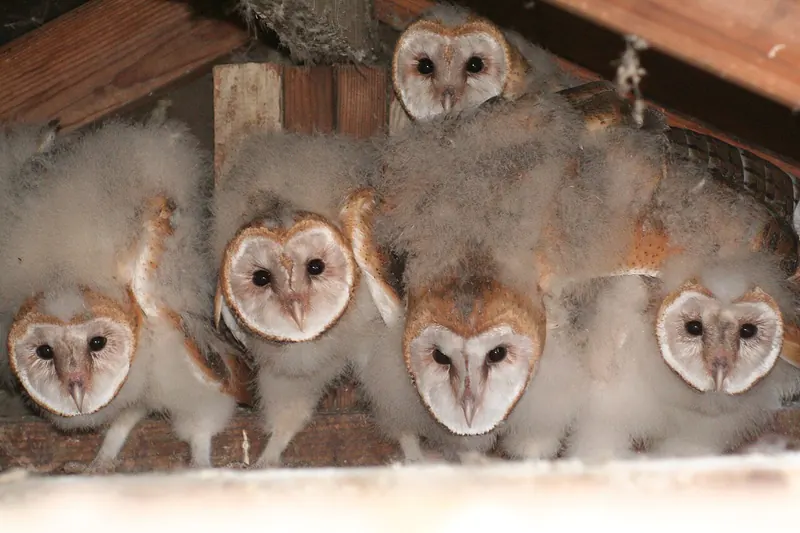
Barn owls don’t build a nest. They lay on a layer of old pellets. source Barn owls typically lay 4–6 eggs (average 4.7). source Barn owls start incubating from the first egg, so after 31–32 days chicks hatch every 2–3 days. The oldest and youngest can be up to three weeks apart. source
The female barn owl does all the incubation and the male brings all the food until the chicks are about 3 weeks old. source At about 6 weeks old, well-fed barn owlets can be 100 g heavier than the adults. source
Barn owlets make their first short flights at 8–9 weeks; on average only 2.5 young fledge per nest. source At about 13 weeks young barn owls leave to find their own home range. source Young barn owls disperse on average 7.8 km; most move less than 10 km. source
About 10% of barn owl pairs may breed twice in a year. source BTO data: barn owl clutches are typically 4–6 eggs (observed range 2–12), incubated for about 32 days, with chicks fledging at around 52–61 days. BTO
Tawny owls
Tawny owls nest early (average first egg 23 March in the UK) and lay 2–3 eggs, incubated for about 30 days. source BTO data: tawny owl clutches are typically 2–3 eggs, incubated 30 days; chicks fledge at around 35–39 days. BTO
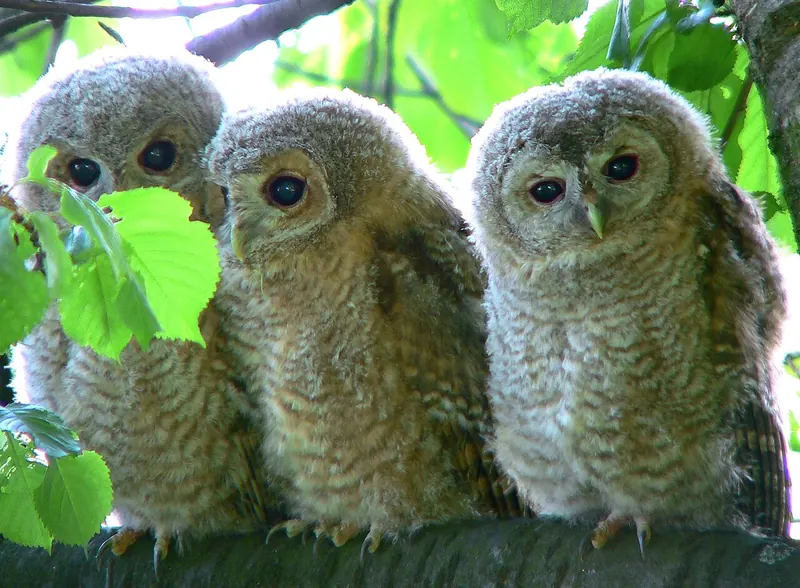
Young tawny owls leave the nest before they can fly. This is called “branching”; their parents keep feeding them wherever they are, even on the ground. source
Owlet ID trick: young tawny owls have vivid pink eyelids; young barn owls have dark eyes and dark eyelids. source
Little, long-eared and short-eared owls
Little owls nest in cavities, mostly tree holes in the UK. They lay 3–5 eggs towards the end of April and incubate them for about a month. source BTO data: little owls typically lay 3–4 eggs, incubated 29–30 days. BTO
Long-eared owls typically lay 3–4 eggs and incubate them for about 28 days. source Short-eared owls lay big clutches: typically 4–7 eggs (up to 9 recorded), incubated for about 26 days. source
How long do owls live?
Most barn owls die in their first year, so average life expectancy in Britain is only about 18 months. source BTO: a barn owl that reaches breeding age typically lives about 4 years. BTO Starvation is thought to be the main cause of barn owl deaths. source
Records differ: the Barn Owl Trust says the oldest barn owl found in Britain was 18 years old (European record 30), while BTO’s ringing record is 15 years 3 months. source BTO maximum age from a ringed barn owl: 15 years, 3 months, 21 days (set in 2016). BTO
BTO: tawny owls reaching breeding age typically live 4 years; the oldest ringed bird reached 23 years 5 months. source BTO: little owls reaching breeding age typically live 3 years; the oldest ringed bird reached 13 years 10 months. source BTO: oldest ringed long-eared owl 12 years 10 months (set in 1987). source BTO: oldest ringed short-eared owl 6 years 7 months (set in 1963). source
Once a barn owl settles a home range it will almost certainly stay for life, and barn owls are very faithful to their mates. source Barn owl home ranges are huge: up to 5,000 hectares in winter, shrinking to about 350 ha in summer. source Barn owls don’t defend territories, so their home ranges can overlap. Tawny owls do defend territories. source A tawny owl territory is 12–20 hectares, and tawnies rarely leave it once settled. source
A young tawny owl on the ground is usually fine: it is “branching” and its parents will feed it. Leave it where it is, or put it up on a branch nearby, the same day and before dusk. source What to do if you find an owlet →