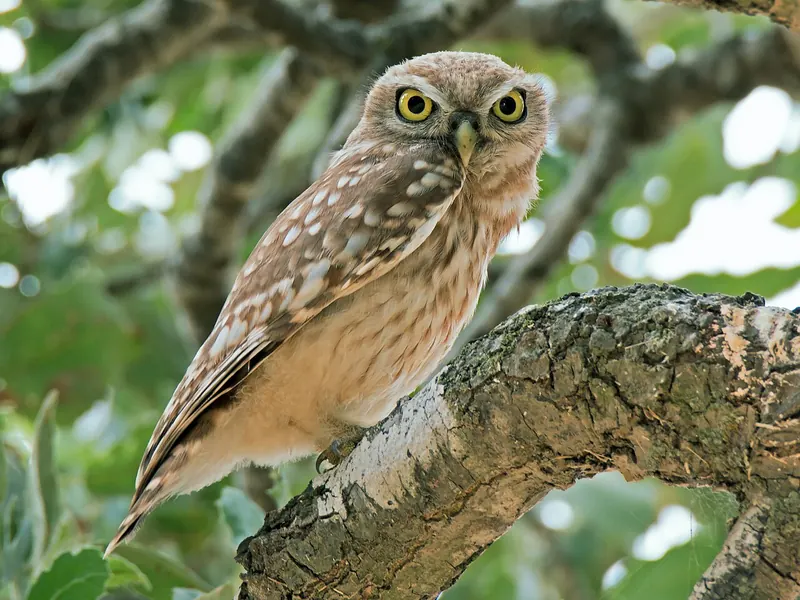
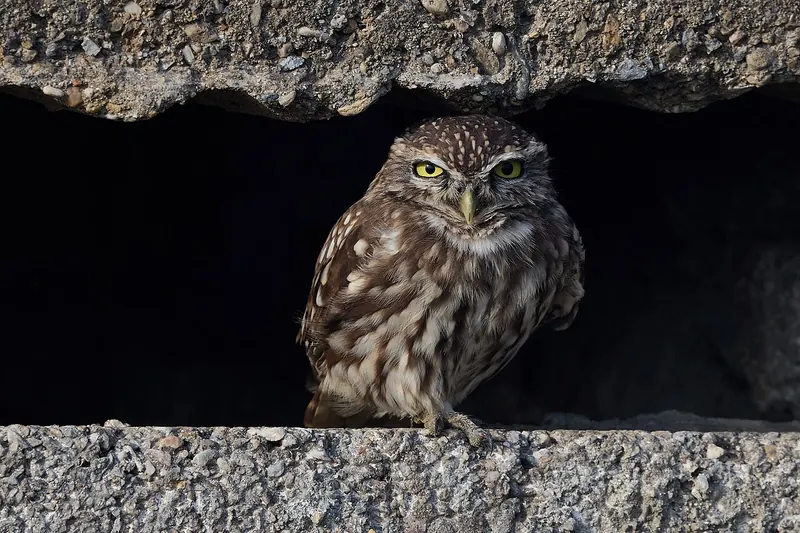
Little owl
Athene noctua · Farmland, old orchards and parkland, mainly in England and Wales
~22 cm tall · 56 cm wings
- Little owl: about 220 mm tall, 560 mm wingspan, pale yellow eyes. Likes mixed farmland and old orchards; largely active by day. source
- The little owl’s call is a plaintive “kiew kiew”, plus a “wherrow” said to sound like a small dog barking. source
- Little owls eat mainly crickets, grasshoppers, beetles and earthworms as well as small mammals, and usually hunt from a perch, typically a fence post. source
- When it spots prey, a little owl sometimes bobs up and down a few times before swooping down. source
- Little owls were introduced to England in the 1800s, and they are absent from Ireland. source
- BTO puts little owls at about 3,600 pairs (2016), with a fall of 88% (1967–2024). source
- The Barn Owl Trust estimates around 6,000 pairs of little owls in Britain. source
- Little owl: “Not assessed”. It was introduced to Britain in the 19th century, so it isn’t given a UK conservation colour. source
- Little owls nest in cavities, mostly tree holes in the UK. They lay 3–5 eggs towards the end of April and incubate them for about a month. source
- Little owl pellets are different from other owl pellets, but similar to kestrel pellets. source
- BTO: little owls reaching breeding age typically live 3 years; the oldest ringed bird reached 13 years 10 months. source
- The first documented little owl record in Britain was in Greater London in 1758. source
- The little owl’s scientific genus, Athene, commemorates the Greek goddess Athena, and a little owl with an olive branch appears on the modern Greek one-euro coin. source
Scientific name checked against Wikipedia.